Cellwise-robust iterative regression imputation for mixed data
Source:R/imputeCellwise.R
imputeCellIRMI.RdExtends IRMI (Templ, Kowarik, and Filzmoser, 2011) with cellwise contamination handling. Each conditional regression uses a cell-weighted IRWLS engine where per-cell weights in the design matrix downweight contaminated cells without discarding entire observations.
imputeCellIRMI(
  data,
  method = "tukey",
  alpha = NULL,
  maxit = 100,
  maxit_irwls = 50,
  eps = 0.005,
  eps_irwls = 1e-06,
  uncert = "pmm",
  weight_update = "multivariate",
  init_weights = "ddc",
  hard_threshold = 0.5,
  trace = FALSE
)
Arguments
- data
a
data.framewith missing values (mixed continuous and categorical variables are supported).- method
weight function:
"tukey"(default, Tukey bisquare) or"huber"(Huber).- alpha
tuning constant.
NULL(default) uses 1.345 for Huber and 4.685 for Tukey, giving 95% efficiency at the normal model.- maxit
maximum number of outer IRMI iterations (default: 100).
- maxit_irwls
maximum number of inner IRWLS iterations per regression (default: 50).
- eps
convergence tolerance for the outer loop (default: 5e-3). Convergence is declared when the relative change in imputed values falls below this threshold.
- eps_irwls
convergence tolerance for the inner IRWLS (default: 1e-6).
- uncert
imputation uncertainty method:
"pmm"(predictive mean matching, default),"normalerror"(add normal noise), or"resid"(bootstrap residual).- weight_update
strategy for updating cell weights between outer iterations:
"multivariate"(default) uses an MCD-based multivariate update for weight coherence across variables, or"univariate"updates each variable independently from its residuals.- init_weights
method for initialising cell weights, one of
"ddc"(default; DetectDeviatingCells, requires the cellWise package and falls back to univariate weights when it is unavailable),"univariate"(per-column median/MAD standardisation), or"mcd"(minimum covariance determinant on the continuous block). The default is"ddc"because"mcd"downweights high-leverage points that carry the regression signal, which can make imputation worse than unconditional median imputation.- hard_threshold
numeric in \([0, 1]\). After convergence, cells with weight below this value are flagged as contaminated (default: 0.5).
- trace
logical; if
TRUE, print progress information.
Value
A list with components:
- data_imputed
the imputed
data.frame.- cellweights
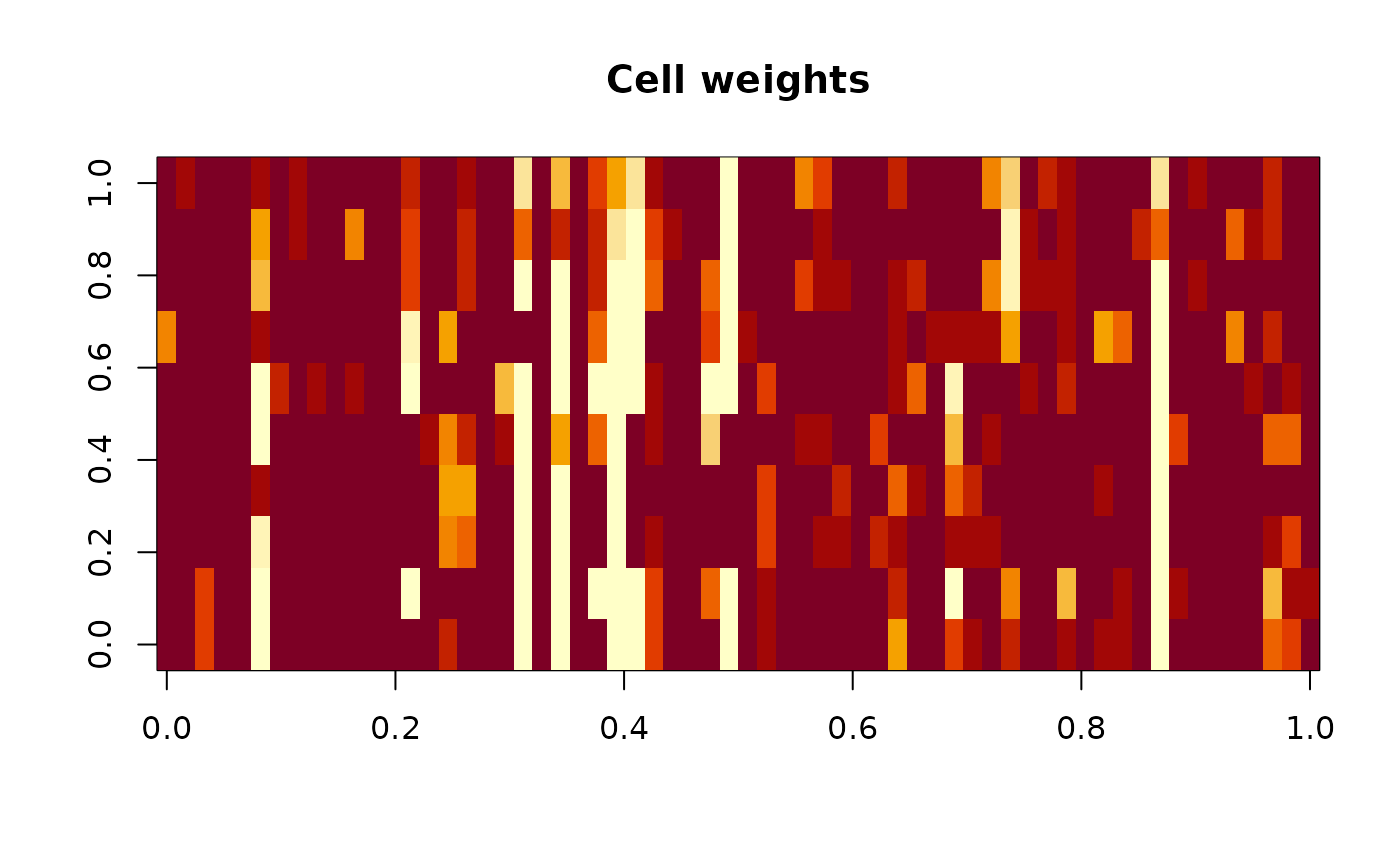
\(n \times p\) matrix of final cell weights (1 = clean, 0 = fully downweighted). Categorical columns always have weight 1.
- converged
logical indicating whether the outer loop converged.
- iterations
number of outer iterations used.
Details
The algorithm works iteratively: in each outer iteration, every variable
with missing values is used as response in a conditional regression on
all remaining variables. For continuous responses, the custom
cellIRWLS() engine fits a weighted regression where each cell in
the design matrix receives its own weight reflecting potential cellwise
contamination. For categorical responses, a weighted multinomial model
is used. After each regression, cell weights for the response variable
are updated from the residuals.
The algorithm proceeds as follows:
Missing values are initialised using
initialise.Initial cell weights are computed with
cellWeights()on all continuous variables in the initialised data.Outer loop (up to
maxititerations):For each variable \(j\) with missing values:
Form predictor matrix \(X\) (all other variables) and response \(y\) (variable \(j\)).
If \(j\) is continuous: fit
cellIRWLS(X, y,
            w_cell, w_response)
and impute missing values in \(j\) using the fitted model plus uncertainty.If \(j\) is categorical: fit
nnet::multinom()with row weights derived from the cell weight matrix and impute by sampling from predicted probabilities.Update cell weights for \(j\) from residuals via
cellWeightsFromResiduals().
Check convergence: relative change in imputed values falls below
eps.
References
Templ, M., Kowarik, A. and Filzmoser, P. (2011). Iterative stepwise regression imputation using standard and robust methods. Computational Statistics & Data Analysis, 55(10), 2793–2806.
See also
imputeCellM, imputeCellEM,
initialise, irmi
Other imputation methods:
hotdeck(),
impPCA(),
imputeCellEM(),
imputeCellM(),
imputeCellMCD(),
imputeCellwise(),
imputeRobust(),
imputeRobustChain(),
irmi(),
kNN(),
matchImpute(),
medianSamp(),
rangerImpute(),
regressionImp(),
sampleCat(),
vimmi,
vimpute(),
xgboostImpute()
Examples
# \donttest{
data(sleep, package = "VIM")
result <- imputeCellIRMI(sleep)
head(result$data_imputed)
#> BodyWgt BrainWgt NonD Dream Sleep Span Gest Pred Exp Danger
#> 1 1.000 5.0 8.3 2.1 10.3 38.6 100 3 3 3
#> 2 1.000 6.6 6.3 2.0 8.3 4.5 42 3 1 3
#> 3 3.385 44.5 8.4 2.0 10.6 14.0 60 1 1 1
#> 4 0.920 5.7 8.3 2.1 10.7 3.5 25 5 2 3
#> 5 1.400 8.1 2.1 1.8 3.9 34.0 42 3 1 4
#> 6 0.425 11.4 9.1 0.7 9.8 27.0 180 4 4 4
image(result$cellweights, main = "Cell weights")
 # With Huber weights (less aggressive downweighting)
result2 <- imputeCellIRMI(sleep, method = "huber", trace = TRUE)
#> hard thresholding removed 79 outlying cells (set to NA)
#> --------------------------------------
#> cellIRMI: start of iteration 1
#> imputing variable: 1 ( BodyWgt ) - continuous
#> imputing variable: 2 ( BrainWgt ) - continuous
#> imputing variable: 3 ( NonD ) - continuous
#> imputing variable: 4 ( Dream ) - continuous
#> imputing variable: 5 ( Sleep ) - continuous
#> imputing variable: 6 ( Span ) - continuous
#> imputing variable: 7 ( Gest ) - continuous
#> imputing variable: 9 ( Exp ) - continuous
#> multivariate weight update: flagged cells = 0
#> convergence criterion: 0.738809
#> --------------------------------------
#> cellIRMI: start of iteration 2
#> imputing variable: 1 ( BodyWgt ) - continuous
#> imputing variable: 2 ( BrainWgt ) - continuous
#> imputing variable: 3 ( NonD ) - continuous
#> imputing variable: 4 ( Dream ) - continuous
#> imputing variable: 5 ( Sleep ) - continuous
#> imputing variable: 6 ( Span ) - continuous
#> imputing variable: 7 ( Gest ) - continuous
#> imputing variable: 9 ( Exp ) - continuous
#> multivariate weight update: flagged cells = 1
#> convergence criterion: 0.021655
#> --------------------------------------
#> cellIRMI: start of iteration 3
#> imputing variable: 1 ( BodyWgt ) - continuous
#> imputing variable: 2 ( BrainWgt ) - continuous
#> imputing variable: 3 ( NonD ) - continuous
#> imputing variable: 4 ( Dream ) - continuous
#> imputing variable: 5 ( Sleep ) - continuous
#> imputing variable: 6 ( Span ) - continuous
#> imputing variable: 7 ( Gest ) - continuous
#> imputing variable: 9 ( Exp ) - continuous
#> multivariate weight update: flagged cells = 1
#> convergence criterion: 0.005233
#> --------------------------------------
#> cellIRMI: start of iteration 4
#> imputing variable: 1 ( BodyWgt ) - continuous
#> imputing variable: 2 ( BrainWgt ) - continuous
#> imputing variable: 3 ( NonD ) - continuous
#> imputing variable: 4 ( Dream ) - continuous
#> imputing variable: 5 ( Sleep ) - continuous
#> imputing variable: 6 ( Span ) - continuous
#> imputing variable: 7 ( Gest ) - continuous
#> imputing variable: 9 ( Exp ) - continuous
#> multivariate weight update: flagged cells = 1
#> convergence criterion: 0.00244
#> cellIRMI converged.
# Mixed data example
data(testdata)
result3 <- imputeCellIRMI(testdata$wna)
# }